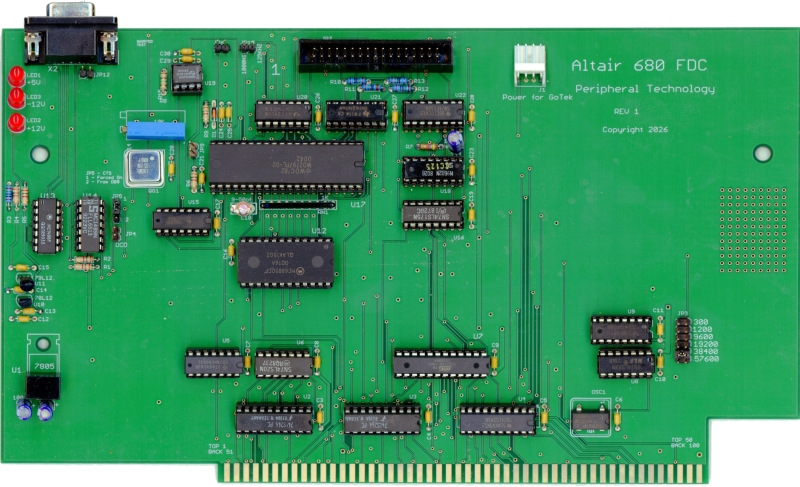
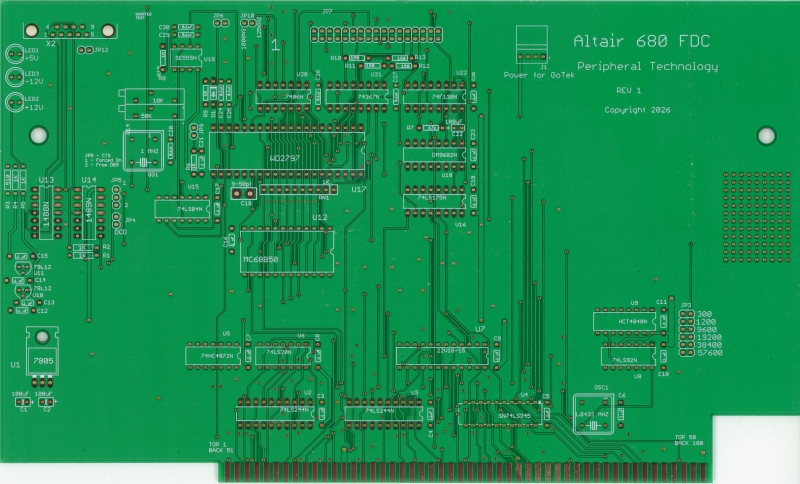
For comparison the FDC680 supports the same floppy disk density as SWTPC did with their DC1, DC2 and DC3 controllers. If you make the 1MHZ modification to your main board, the FDC680 will support double density operation. For an 80 track double sided, double density drive, this gives 2844 sectors of free space on a formatted FLEX disk. If using a GoTek format with 240 tracks this gives you 8604 free sectors or 2,202,624 bytes.
When using the MIO board, FLEX supports the SD card and the Floppy Controller.
Default drive assignments when booting from the SD card:
0 - SD Card - Partition 0 - Boot Partition
1 - SD Card - Partition 1
2 - Floppy - With floppy strapped as Drive 0
3 - SD Card - Partition 2
Minimum System Requirements without MIO Board - For FLEX
Memory from A000-BFFF - FLEX loads here
Memory from 2000-FFFF - Bootstrap loader loads at 2400
Memory from 0000-0FFF - Memory for Programs
You should really have 16K of memory from 0000-3FFF if you want to do anything useful.
This version of Flex will use some routines in the Altair monitor. You will need to enter a small program using the Altair monitor or you can upload the small program in S-Record format by using the file transfer of a terminal program like Tera Term. If you have the ability to program 1702s you could place the loader in a 1702 and then jump to it using the "J" command in the Altair monitor.
Downloads
Manuals:
FDC680 User Manual User Manual and Parts List for MIO
JED PAL FILES
Software Manuals
Flex user manuals can be found at the bottom of the MIO web page - https://peripheraltech.com/MIO.htm
| FDC680-ASM | Floppy Controller Board - Assembled - Without RS232 | $99 |
| FDC680-RS232 | For Assembled board - Add to populate RS232 Section | $25 |
| FDC680-Bare | Floppy Controller Board - Bare | $39 |
| FDC6800-PAL | Replacement PAL for FDC6800 | $5 |